
What's included
- Brush, vines and thickets cleared, usually by mulching them in place so the ground stays covered
- Small trees cleared with the brush, up to a size judged at the site visit. Larger trees are identified first as keep or remove; those removed are felled first by a logger
- Stumps dealt with to suit the use: ground below grade where you need to mow or drive, or grubbed out where the ground must be fully clear
- A lane or access opened so you can reach the cleared area
- Edges and boundaries agreed before work starts, so the finish stops where you want it to
Every job begins by identifying what stays. Selective clearing is the default, not an extra.
Keeping the ground covered matters more than it looks. According to the U.S. Environmental Protection Agency, erosion from construction sites ranges from 7.2 to 500 tons per acre per year, while natural erosion from forests or well-sodded land is typically less than 1 ton per acre per year (source: U.S. Environmental Protection Agency). Mulching in place leaves the roots and a mulch layer, not bare dirt.
Before and after
Drag the handle to compare.
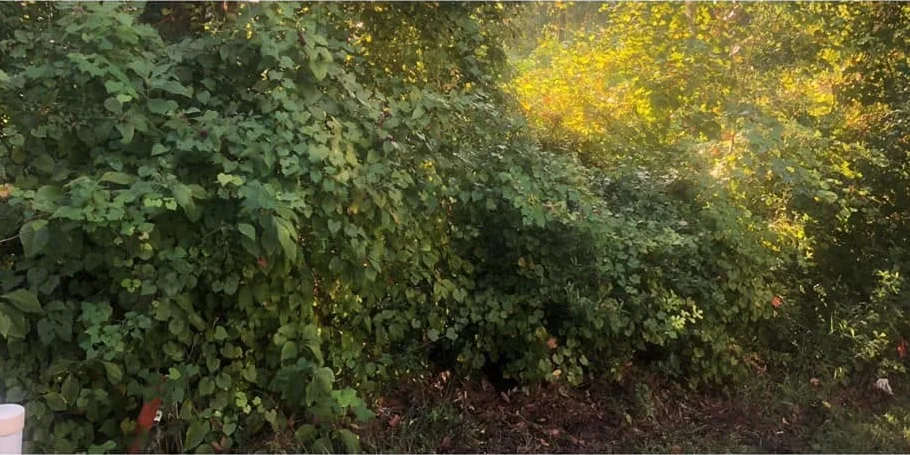
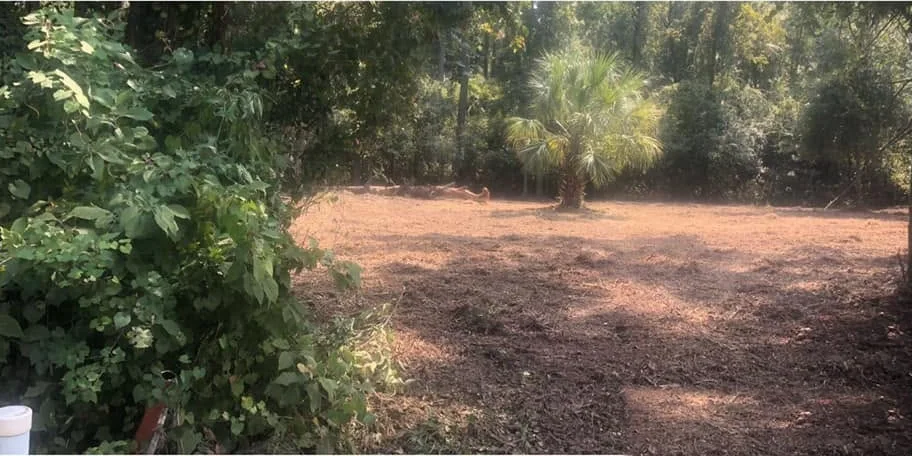 BeforeAfter
Dense overgrowth turned into usable, accessible space.
What's not included
Clearing stops at the vegetation. The following are different trades, and we will say so if your plan needs them:
- Excavation, grading and soil stabilization (an excavation or site contractor)
- Driveway building and culverts (a site contractor)
- Demolition of structures (a demolition contractor)
- Debris hauling with a dump trailer (a hauling service); cleared material is left as mulch, not piled or trucked
- Herbicide treatment of regrowth (a licensed applicator)
Typical lot scenarios
The overgrown residential lot. A lot bought years ago, or inherited, has closed in with privet, smilax and sweetgum. You want to see the boundaries, walk it and decide what to do next. Mulching opens it in one pass and keeps the mature oaks and pines.
The parcel ahead of a build. You have a house or barn planned and need the footprint and access clear before your builder and excavator arrive. We clear vegetation and leave the earthwork to them. See Prepare a homesite or building lot.
The larger tract with lost access. Old roads and openings on a rural property have grown shut. You want the lanes back and the fields' edges pushed out, without losing the hardwood bottoms or the big trees along the drive.
The lot that just needs to be mowable. Brush is gone but the stumps stop you from mowing. Grinding alone may be the right job.
Process and timing
- Understand the property. You tell us the town or county, the approximate acreage, what is in the way and what to keep, and send a few photos of the area and the access.
- Define the work. We agree the scope, boundaries and intended finish, including how stumps are handled and where the edges fall.
- Put the plan to work. We carry out the clearing with attention to the surrounding land and the result in mind.
How long a lot takes depends on density, stem size, terrain and access. A small lot of light brush may be a partial day; a wooded tract of sweetgum thicket may take several days. RRE does not publish acreage-per-day figures; the project quote after a site visit sets the expectation. Soft ground after rain can shift the schedule, especially in the Lowcountry.
Permits
Ordinary vegetation clearing on private rural land in South Carolina and Georgia generally does not need a state permit. Counties and towns are a different matter. Beaufort County, Bluffton and Hilton Head Island, among others, regulate removal of protected and specimen trees, and wetlands and buffers are regulated separately by state and federal agencies. Permits, buffers and tree-protection compliance are the landowner's responsibility. Check with your county before you clear, and read Do you need a permit to clear land in South Carolina or Georgia?. [FPO: RRE's permit policy and which approvals the owner must hold before work starts — VAL-041]
What does RRE's lot clearing look like?
The clearest example of RRE lot clearing is the overgrowth removal project: thick vines and brush became an open mulched area around a retained palm. Two further projects, a woodland clearing and an understory clearing (the brush and small trees under the canopy), show the same approach under mature trees. See overgrowth removal. [FPO: location, date and approximate acreage for each project — DEP-28]
Frequently asked questions
What does lot clearing cost?
It depends on acreage, how dense the growth is, the size of the trees, access for the machine, distance and what you want done with stumps. We do not publish prices. Estimates are free and require a site visit; RRE quotes by project, never per acre or per hour, and a 25% deposit is required to schedule.
Can you clear just part of a lot?
Yes. Most jobs are partial. We mark the boundaries and the trees to keep before starting, and the finish stops where we agreed.
What does the lot look like when you are done?
Open ground with a mulch layer over the soil, the kept trees standing, and stumps either cut low, ground or grubbed depending on what you chose. No piles and no bare dirt.
Will I still need an excavator?
Only if your plan calls for moving soil, grading, a driveway or a foundation pad. If it does, we clear first so the excavation contractor arrives to open ground.
Will the brush come back?
Some regrowth is normal, especially from privet, kudzu and tallow, because mulching leaves roots in the ground. A follow-up cut, as a maintenance visit scheduled ahead or requested as needed, or treatment by a licensed applicator slows it.
Sources
- U.S. Environmental Protection Agency, National Management Measures to Control Nonpoint Source Pollution from Urban Areas, Chapter 8: Construction Site Erosion, Sediment, and Chemical Control (source: U.S. Environmental Protection Agency)