
What are you actually looking at?
Chinese privet (Ligustrum sinense) is a thick, semi-evergreen shrub that reaches 20 to 30 feet with multiple trunks, according to UGA Extension and the Georgia Forestry Commission. The USDA Forest Service field guide to invasive plants in Southern forests puts it at up to 30 feet (source: USDA Forest Service). The leaves are small, oval, and opposite on the stem. It holds most of its leaves through winter. That is why a privet understory, the brush layer under the canopy, looks like a solid green wall in January when everything else is bare.
Small white flowers in late spring become waxy, dark purple to black berries that hang on through winter. Under a mature thicket almost nothing grows; the SC Exotic Pest Plant Council notes that very few plants are found beneath thick stands of privet. If you see pine trunks above the wall but no ground, no seedlings, and no light below it, that is this condition.
Before and after
Drag the handle to compare.
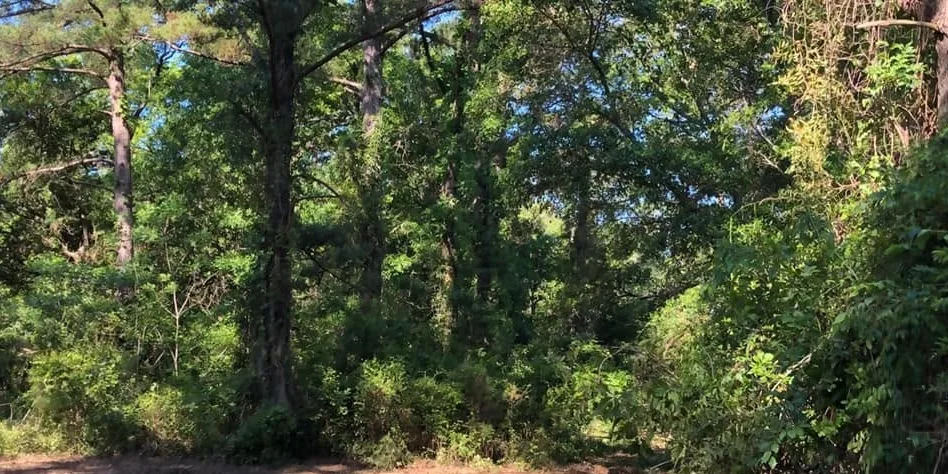
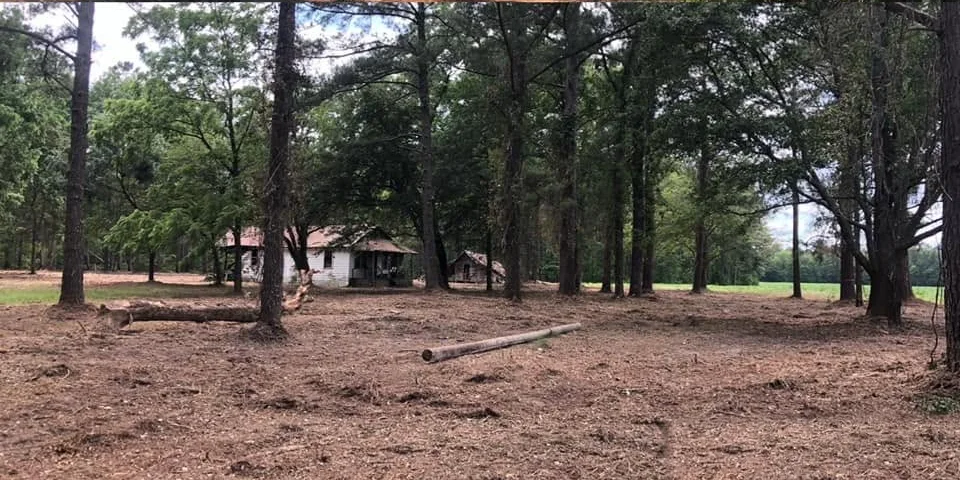 BeforeAfter
Opening up wooded land while keeping the established trees.
Why does privet take over woods in GA and SC?
Privet came from China in the 1800s as a hedge plant. The Georgia Exotic Plant Pest Council now lists it as a Category I invasive. Non-native privet ranks first on the Georgia Forestry Commission's 2021 Dirty Dozen list of invasive plants; by 2019 Forest Inventory and Analysis data it occupied roughly 717,000 acres of Georgia forest (source: Georgia Forestry Commission). The SC Exotic Pest Plant Council rates it a severe threat in all three regions of South Carolina. It thrives in forest interiors, not just disturbed edges. In the Lowcountry and Coastal Plain it is densest in bottomlands, along fencerows, and along rights-of-way.
It spreads two ways at once. Birds and mammals eat the berries and drop seed under every perch tree, and in floodplains floodwater carries seed downstream, per Clemson HGIC. Meanwhile the roots sprout new plants as they spread, and new plants grow from small root fragments left in the soil. The USDA Forest Service field guide describes the same pattern: privet colonizes by root sprouts and spreads widely by bird- and animal-dispersed seed (source: USDA Forest Service). A privet thicket is both a seed problem and a root problem, and clearing addresses only the part above ground.
What can forestry mulching do about it?
Forestry mulching takes the entire above-ground thicket down in one operation and leaves it as a mulch layer. A mulching head grinds stems, limbs, and leaves together while the pines, hardwoods, and anything else on your keep list stay standing.
Light reaches the ground, you can walk and see through the woods, and the roots of your canopy trees are left undisturbed. The ground layer can recover. In USDA Forest Service research on Georgia riparian forests, plots where privet had been mulched, with the regrowth then treated by herbicide, carried almost 70 percent herbaceous cover after removal, and uninvaded reference plots carried over 60 percent (source: USDA Forest Service). For open, park-like woods, mulching is the mechanical step; see understory reclamation. What mulching cannot do is kill the plant. Extension guidance is consistent that repeated cutting controls privet's spread but does not eradicate it.
What won't mulching do, and who does that?
RRE does not apply herbicide, and lasting privet control in both states relies on it. The Georgia Forestry Commission's guide lists four methods:
- leaf (foliar) sprays in the growing season
- directed sprays in the dormant season, November through February
- basal bark treatments on the lower trunk
- cut-stump treatments
It says two treatments can eradicate most stands. UGA Extension calls herbicide the most effective option for thickets. That work belongs to a licensed pesticide applicator, who can treat fresh regrowth after mulching far more efficiently than a 20-foot wall. The Virginia Department of Forestry's privet factsheet says the same: mechanical removal with hand tools or heavy equipment is effective, especially when combined with foliar or stump herbicide treatment, because privet resprouts from roots and stumps (source: Virginia Department of Forestry).
RRE does not burn; a certified prescribed burn manager with a written plan does, and RRE can build and maintain the firebreaks. RRE does not haul, so there are no privet piles; the material stays as a mulch layer. Privet along a creek or wetland may sit inside a buffer, which is the county's or a wetland consultant's call.
What does the work look like?
The site visit comes first. RRE walks the thicket edge with you to understand the property, then defines the work: the boundary of the work area, the keep list, and the intended finish. In privet woods the keep list is usually the canopy trees plus any native understory hiding in the wall, such as dogwood, holly, or young oaks. Those are flagged on the ground and written into the scope.
The finish is usually medium: coarse enough to be quick, fine enough that a sprayer or mower can follow. Privet stems grow inches apart, so the density is almost always heavy. Equipment is chosen at the site visit. RRE schedules this under invasive growth management or as part of a larger clearing; most privet understories are a one-to-two-day to several-day project.
What happens afterward?
The first growing season brings a flush of sprouts from cut stumps and roots, plus whatever seed the birds dropped over winter. If a licensed applicator treats that regrowth while it is knee-high, the second season is far quieter.
Without chemicals, the realistic plan is a maintenance visit, scheduled ahead or requested as needed. It mulches or mows the regrowth every year or two and keeps the woods open, even though the privet is never fully gone. Either way, the first season after clearing is the cheapest moment to act. See regrowth: what comes back and when.
Rules that may apply
Mulching that leaves roots and soil in place is generally treated differently from grubbing and grading, but the threshold is set by the state and county. In South Carolina, as of October 2026, disturbing 1 acre or more requires coverage under the SCDES Construction General Permit. Sites under 1 acre submit a Notification Form (SCDES Form 2628) and receive a letter of exemption before work begins (source: SCDES). In Georgia, as of October 2026, projects under 1 acre are exempt unless part of a larger common plan or within 200 feet of the bank of state waters. A 25-foot undisturbed buffer applies along state waters (source: Georgia EPD).
Privet loves bottomlands, so a thicket often runs to a creek or wetland edge. South Carolina buffers are covered on stream and wetland buffers; confirm the current rule with SCDES or the county before work near water. Permits and buffer compliance are the landowner's responsibility.
Frequently asked questions
Will the privet come back after mulching?
Yes. Chinese privet sprouts from its roots and cut stumps, and birds bring new seed every winter, so expect a carpet of soft sprouts in the first growing season. Mulching opens the woods and makes regrowth easy to reach; it does not kill the plant. A maintenance visit keeps the woods open, and a licensed pesticide applicator treating the regrowth is what Extension recommends for lasting control.
Can RRE spray the regrowth?
No, RRE does not apply herbicide or any chemical treatment. The Georgia Forestry Commission and UGA Extension describe foliar, basal bark, and cut-stump herbicide treatments as the effective long-term controls for privet. That work belongs to a licensed pesticide applicator. RRE does the mechanical clearing first so the applicator treats knee-high regrowth instead of a 20-foot wall.
Will mulching the privet hurt my pines?
The mulching head works between the trees, and the pines and hardwoods on your keep list are flagged and written into the scope before work starts. The main thing RRE watches is the root zone, because a tracked machine running repeatedly over the same roots can compact soil. Where trees are close, the operator limits passes.
Is there a best season to mulch privet?
Any season works for the mechanical step. Winter has one advantage: privet keeps its leaves when native plants are bare, so it is easy to see what is privet and what is worth keeping. If a licensed applicator will follow, ask them about timing; the Georgia Forestry Commission lists dormant-season sprays from November through February and growing-season foliar sprays as separate options.
Sources
- Georgia Forestry Commission, Invasive Plants of Georgia's Forests: gatrees.org
- SC Exotic Pest Plant Council, Invasive Plant Pest Species of South Carolina: se-eppc.org
- UGA Extension (Fulton County), Setting Boundaries with Small-Leaf Privet: site.extension.uga.edu
- SE-EPPC Invasive Plant Manual, Privet: se-eppc.org
- Clemson HGIC, Ligustrum: hgic.clemson.edu
- Georgia Forestry Commission, 2021 Dirty Dozen: Top Twelve Nonnative Invasive Plants List (source: Georgia Forestry Commission)
- USDA Forest Service, GTR SRS-119 A Field Guide for the Identification of Invasive Plants in Southern Forests (source: USDA Forest Service)
- USDA Forest Service, Hanula & Horn (2011), Removing an exotic shrub from riparian forests increases butterfly abundance and diversity, Forest Ecology and Management 262:674-680 (source: USDA Forest Service)
- Virginia Department of Forestry, PRIVET: Chinese, European & Japanese factsheet (source: Virginia Department of Forestry)
- SCDES, Less than 1 Acre of Land Disturbance: des.sc.gov
- Georgia EPD, Model Soil Erosion, Sedimentation and Pollution Control Ordinance: epd.georgia.gov