
What understory clearing changes
Light. Privet, yaupon, wax myrtle and sweetgum thickets shade the ground completely. Take them out and light reaches the floor again, and grasses and ground cover can come back.
Access. A wooded tract with a solid understory is one you cannot use. Opening the floor gives you the woods back: trails, a way to the back line, somewhere to sit in the shade.
Fuel. Thick understory is the fuel that carries a ground fire up into the crowns. Removing it reduces that fuel whether or not you ever burn. RRE builds and maintains firebreaks; RRE does not conduct burns, obtain burn permits for clients, or act as burn manager.
Visibility. You see the trunks, the shape of the stand, and anything moving through it. On a hunting property that is the whole point. On a homesite it is the difference between living in the woods and living beside a wall.
Before and after
Drag the handle to compare.
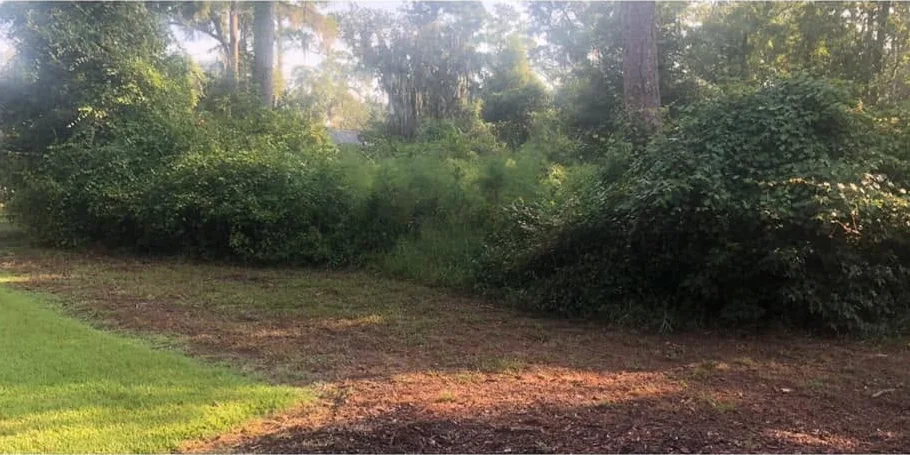
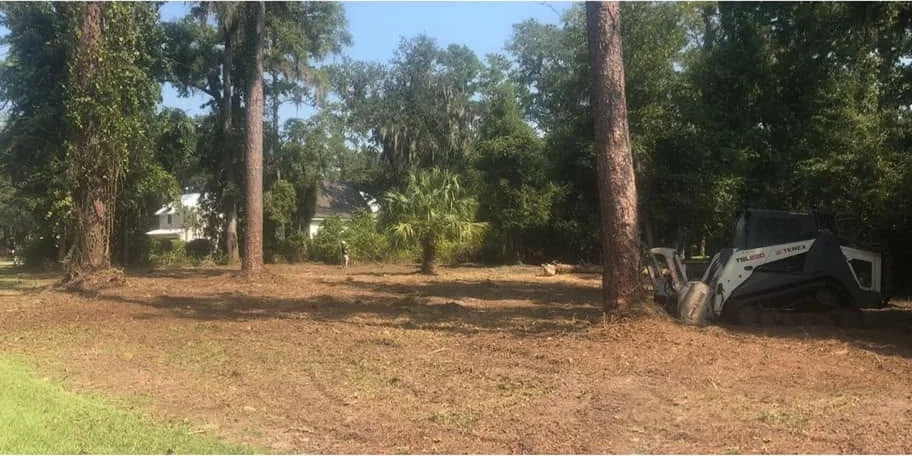 BeforeAfter
Reclaiming space beneath an established canopy.
Protecting roots and trunks
The trees are the reason you are doing this, so the work is planned around them.
- Every kept tree is flagged first. The site visit produces a keep list, flagged on the ground and written into the scope. The operator works to the flags, not to memory.
- Trunks are not touched. Brush against a trunk is worked around, not pushed through. Bark damage on a live oak or longleaf is permanent.
- Roots stay in the ground. Under a canopy the stumps of removed brush are ground low or mulched flush, never grubbed. Grubbing beneath mature trees tears their roots. See stump grinding.
- The mulch layer stays. It covers the root zone, holds moisture and slows erosion. The floor is not stripped bare beneath kept trees.
The exact setback from each trunk, and how the machine moves through the stand, depend on the trees and the ground. Both are judged at the site visit and written into the scope. For the reasoning, read keeping mature trees. For stands where ground disturbance must stay minimal, see conservation clearing & environmental mulching.
Timber and habitat
If you intend to sell the timber, talk to a consulting forester before clearing beneath it. Understory mulching does not remove trees worth selling, and it can make a stand easier for a forester to inventory and mark. The forester should still know what is planned. Read will clearing hurt my timber value?.
Habitat is a choice, not a side effect. Open pine with a grassy floor suits bobwhite; thick understory is bedding cover for deer. Most owners open some blocks and leave others, and the keep list covers ground as well as trees. If wildlife is the goal, bring your biologist or consulting forester to the site visit. RRE does the clearing; it does not design habitat.
Open up your woods
Send hello@rreforestry.com the county, the acreage of the stand, photos looking into the understory, and what you want the floor to be. Request a consultation.
Frequently asked questions
Will the mulching head damage the bark on trees you are keeping?
Not if the work is planned and marked. Kept trees are flagged and the operator works around them with a setback. The risk is highest with unmarked trees in dense growth, which is why the keep list comes first.
Will the big trees die from root damage?
Mulching does not dig. Stumps of removed brush are ground or left low rather than pulled, and the mulch stays over the root zone. Trees are far more likely to be hurt by trucks and stored material during a build than by understory mulching.
Can you take out the sweetgum and privet but leave the hardwoods and pines?
Yes. That is the usual job. Species and size limits for what goes are agreed at the site visit; larger trees are kept or felled first by a logger.
Will it grow back?
Yes, especially privet and sweetgum sprouts, and light on the floor brings up new growth. A mowing pass, a maintenance visit scheduled ahead or requested as needed, or fire where it is part of your plan, keeps it open.