
What are you looking at?
From the road, mature pines or oaks with a green wall under them. Inside, you cannot see 30 feet in any direction. The understory, the brush and small trees under the canopy, is usually a mix. Chinese privet grows in the wetter ground, wax myrtle and yaupon on the sandier flats, sweetgum and water oak saplings everywhere, with smilax and muscadine tying it together.
You cannot walk it, you cannot see a deer in it, and you cannot tell which trees are worth keeping because you cannot get to them. The question is not whether the understory can be opened. It is which trees you keep, and how the machine gets between them without hurting them.
Before and after
Drag the handle to compare.
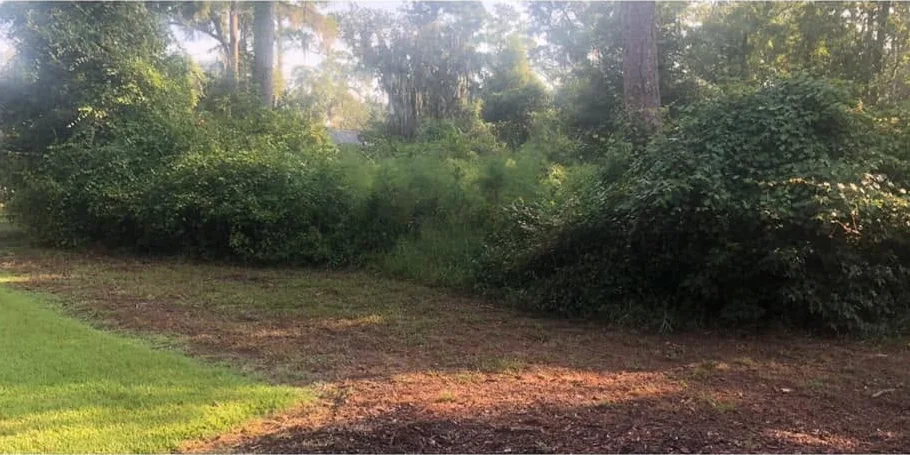
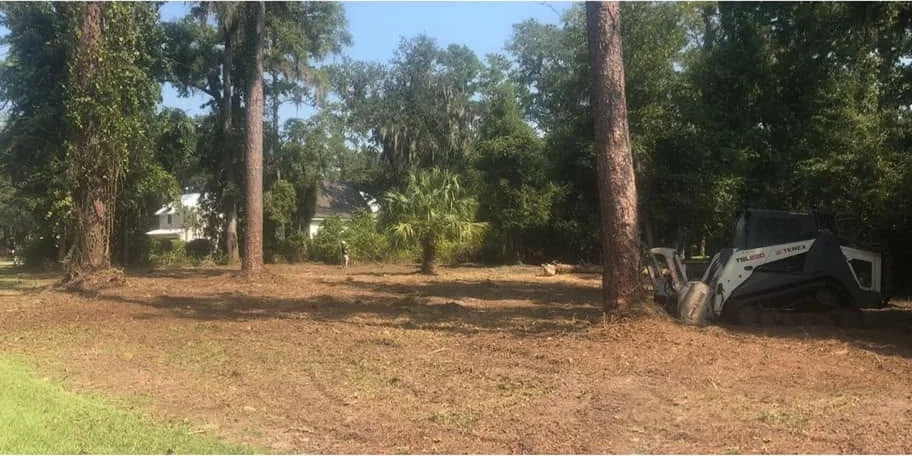 BeforeAfter
Reclaiming space beneath an established canopy.
Why does the understory close here?
Light and fire. A thinned pine stand or an opened hardwood edge lets light hit the ground, and in the Coastal Plain the ground answers fast. Wax myrtle grows "as much as 5 feet in height and width in a single growing season." Its dwarf form "grows primarily in the coastal plain pinelands" where it spreads to form colonies. Chinese privet spreads "both by root sprouts arising from rhizomes and by abundant seed production," and birds carry the seed. Clemson Extension lists it as a severe threat in South Carolina. Sweetgum "sprouts profusely from stumps and lateral roots."
Fire used to reset all of this. Most private woods in Georgia and South Carolina have not burned in decades. Without fire or mowing, the shrub layer grows into a middle layer of small trees (a midstory) that shades out the grasses. Ten years without disturbance closes a Coastal Plain understory; twenty makes it a wall.
What can clearing do?
Selective forestry mulching can take the understory down to a mulch layer while the canopy stays. The operator works between the trees, processing privet, myrtle, vines, and saplings and leaving the stems on the keep list untouched. The result is an open floor under a closed canopy, which is what most owners mean by "open it up."
The keep list is the whole job. Big pines, oaks, hickories, dogwoods, magnolias, and anything else you want are flagged before the machine arrives. What is not on the keep list and is within the machine's range comes down. The stem-size limit depends on the machine, the head, the species, and the density, and it is judged at the site visit. The intended finish is agreed first: rough, with low stubs and a coarse mulch layer, or finer where you plan to mow.
What won't clearing do, and who does that?
Mulching does not protect roots from traffic. A tracked machine spreads its weight, but it still runs over the root zone of every tree it works around. Clemson Extension's advice on construction applies: "Soil compaction cuts off air and water to the tree roots," and the damage "occurs slowly, sometimes not becoming evident for several years." Working dry ground, keeping passes to a minimum near the keep list, and staying off saturated soil reduce the risk; they do not remove it.
Mulching does not remove midstory trees too large for the head; those are kept, or felled first by a logger. Dead limbs over a house are an arborist's job. Chemical control of privet or myrtle roots is a licensed pesticide applicator's work; RRE does not spray. Fire belongs to a certified prescribed burn manager. If the timber is worth selling, a consulting forester should look first.
What does the work look like?
The site visit walks the stand with you. You and RRE agree the keep list tree by tree or by rule ("every oak stays") and flag it on the ground. You also agree the work area, the agreed boundary, and the intended finish. Wet ground and the root zones of the most important trees are noted; the equipment is chosen there.
On the day, the operator works in lanes between the keep list. A moderately dense understory on a few acres is one to two days to several days; the density class, light, medium, or heavy, sets the pace, not the acreage alone. The project ends with a final walk-through under the opened canopy.
What happens afterward?
The mulch layer breaks down over one to several seasons depending on how coarse it is and how wet the site stays. Privet and myrtle send up regrowth from roots and stumps in the first growing season; that is expected, and it is why opened woods need a plan. A maintenance visit scheduled ahead or requested as needed, mowing once the mulch has settled, or a prescribed burn program run by a certified burn manager keep the floor open. Read Does mulch hurt the soil or the trees?. Watch the kept trees for thinning crowns or dieback, which can signal root-zone stress.
Which rules may apply?
Tree protection. Several Lowcountry jurisdictions protect specimen trees. In unincorporated Beaufort County, South Carolina, as of October 2026, specimen trees include live oaks and listed overstory (canopy) species at 16 inches trunk diameter at chest height (DBH). Understory species such as dogwood, redbud, and southern magnolia count at 4 inches, and most other trees at 24 inches. Bluffton, Hilton Head Island, Port Royal, and the City of Beaufort have their own ordinances. Confirm the current threshold before any tree is marked; see Specimen and heritage trees. Compliance is the landowner's responsibility.
Land disturbance. Mulching leaves the ground in place, but the thresholds still apply. As of October 2026, South Carolina requires Construction General Permit coverage at 1 acre or more of clearing, grubbing, grading, or excavating. Under 1 acre, a Form 2628 exemption letter is needed. Georgia exempts projects under 1 acre unless within 200 feet of state waters or part of a larger plan, and forestry land management practices are exempt. Whether mulching counts as land disturbance is interpreted by the county; confirm before a large project.
Protected features. RRE stops work when it finds a gopher tortoise burrow, cavity tree, or grave. As of October 2026, red-cockaded woodpecker cavity trees and listed bats can affect timing; confirm with USFWS and SCDNR or Georgia DNR.
Frequently asked questions
Will the machine damage the roots of the trees I keep?
It can, and no honest operator promises otherwise. A tracked machine spreads its weight, but it still crosses root zones, and soil compaction cuts off air and water to roots with damage that can take years to show. RRE reduces the risk by working dry ground, limiting passes near the keep list, and routing lanes away from the most important trees. The tradeoff is agreed at the site visit.
How do I decide what goes on the keep list?
Walk it with the operator at the site visit. Most owners keep every canopy tree, the mast trees, and anything with sentimental or screening value, and remove privet, myrtle, vines, and saplings. A rule such as "every oak stays" is written into the scope alongside the flagged trees. A consulting forester can add a timber view if the timber is worth selling.
What comes back, and how soon?
Privet, wax myrtle, and sweetgum sprout from roots and stumps in the first growing season after mulching, and seedlings follow in the second. Opened woods stay open with a maintenance visit scheduled ahead or requested as needed, or with mowing once the mulch has settled. A prescribed burn program run by a certified burn manager also works. RRE does not spray or burn.
Sources
- Clemson HGIC, Waxmyrtle: hgic.clemson.edu
- Clemson HGIC, Ligustrum (including Chinese privet): hgic.clemson.edu
- UGA Extension, Native Plants for Georgia Part I (sweetgum entry): fieldreport.caes.uga.edu
- Clemson HGIC, Protecting Trees During Construction: hgic.clemson.edu
- Beaufort County Planning Commission agenda quoting Sec. 5.11.100 (specimen trees): beaufortcountysc.gov
- SCDES, NPDES stormwater program: des.sc.gov
- SCDES, Less than 1 Acre of Land Disturbance: des.sc.gov
- Georgia EPD, Model Soil Erosion, Sedimentation and Pollution Control Ordinance: epd.georgia.gov
- USFWS (protected species guidance): fws.gov