
Direct definition
In RRE's own words: forestry mulching clears brush and small trees to open up property, improve access, and make overgrown areas easier to maintain. The material is ground in place and left as a mulch layer.
That last part is the difference from most other clearing. Bulldozing and excavation push vegetation and topsoil into piles that then have to be burned or hauled. Bush hogging cuts grass and light brush but cannot handle saplings. Mulching takes standing vegetation down to a layer of chips in one operation, with the roots and soil left where they are.
Before and after
Drag the handle to compare.
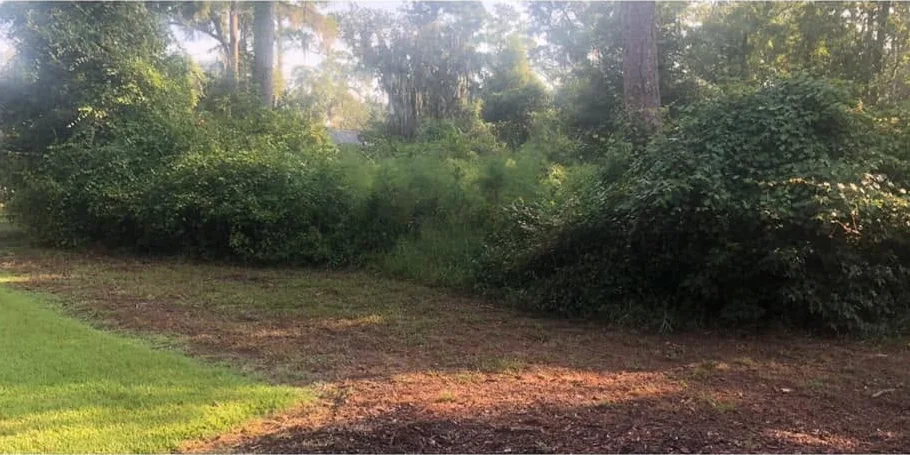
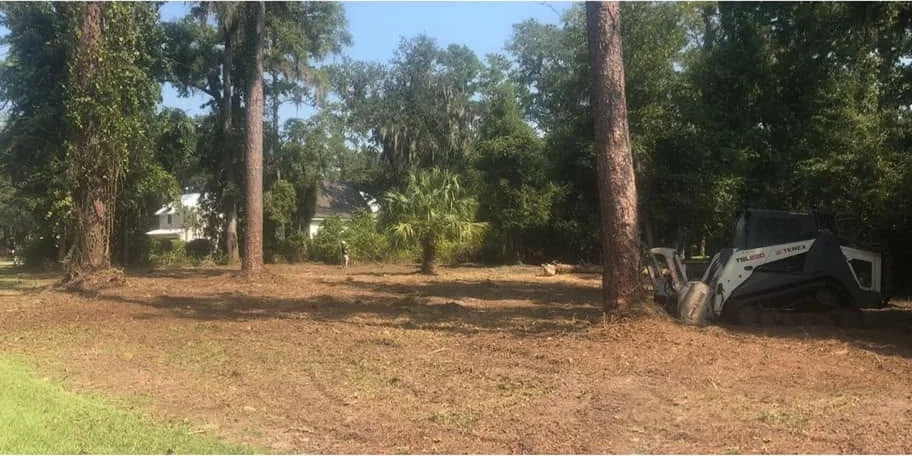 BeforeAfter
Reclaiming space beneath an established canopy.
How it works (mulching head on a tracked carrier)
The machine is a tracked carrier with a mulching head mounted on the front. The head is a steel drum fitted with cutting teeth that spins at high speed. The operator raises the head, lowers it onto standing vegetation and works it down through the stem. A sapling or shrub is chewed from the top rather than pushed over. Once the material is on the ground, a second pass over it sizes the chips and spreads them.
Tracks spread the machine's weight over a wide footprint, which lets it work on soft ground and over roots without rutting the way wheeled equipment can. The carrier is compact enough to move between retained trees and along fence lines. The operator can clear right up to a trunk you want to keep and leave it untouched.
RRE runs two high-flow Terex tracked machines with mulching heads, and a stumper for stump work. The equipment for a job is chosen at the site visit. More on the forestry mulching service page.
What it clears
In Mid and South Georgia and the South Carolina Midlands and Lowcountry, the growth that makes a property hard to use is usually a mix of the following. All of it is mulcher work:
- Woody brush: wax myrtle, yaupon, Chinese privet, sweetgum thickets, young tallow.
- Vines: smilax (greenbrier), muscadine, wisteria, kudzu.
- Palmetto and saw palmetto in the Lowcountry.
- Pine and hardwood saplings that have come up in old fields, cutovers and fence lines.
- Small trees that have grown under a mature canopy.
- Running bamboo canes, with the understanding that the rhizomes remain.
The line between a small tree and one that should be felled first depends on the species and the finish you want. RRE judges it at the site visit. Larger trees are kept, or a logger fells them first. That question has its own guide: what a forestry mulcher can clear and what it can't.
What it leaves
A finished mulching job looks like open ground between the trees you kept, covered in a layer of shredded wood and leaf. The layer is thin where the brush was light and thicker where a thicket stood. Stumps of mulched stems are cut close to ground level and often ground into the mulch. Stumps of larger felled trees remain unless grinding or grubbing is part of the job.
RRE's three documented projects show the finish:
- A woodland clearing: dense brush beneath mature trees became open ground between the retained trees.
- An overgrowth removal: thick vines and brush became an open mulched area around a retained palm.
- An understory clearing: a dense understory (the brush and small trees under the canopy) became a mulched open area beneath mature trees.
[FPO: locations, dates and acreage for the three before/after pairs — DEP-28] See our work for the photos. What the layer does over the following months is covered in what happens to the mulch after clearing.
Advantages and limits
Advantages:
- No burn piles, so no smoke, no burn notification and no waiting on weather.
- Trees and features you want to keep stay in place. The work is selective by design.
- The soil is not stripped. The mulch covers it, slows runoff and holds moisture.
- The site is walkable and usable as soon as the machine leaves.
Limits:
- Mulching is not a way to remove large timber. Big trees are felled by other means or left.
- Roots and stumps stay in the ground unless stump work is added.
- It does not change the shape of the ground.
- Regrowth is expected from root sprouts and the seed bank, so a plan for follow-up matters. See regrowth after mulching.
- Saturated ground can slow or stop the work, which in the Lowcountry is a seasonal reality. Tracks help, but a high water table can hold water for weeks.
When to choose something else
- You need a building pad, driveway or changed drainage: mulching can clear the vegetation first, then an excavation or grading contractor does the earthwork.
- Standing timber has value: talk to a consulting forester or logger about a harvest before anything is mulched.
- Roots must come out, for a food plot, a lawn or a foundation: add stump grubbing or plan for an excavation contractor.
- The brush has to leave the property: mulching keeps it on site by design, so a contractor with hauling is the right call.
- Long-term control of kudzu, privet or tallow: mechanical clearing knocks it back, and a licensed applicator handles any herbicide follow-up.
A side-by-side view is in forestry mulching vs bulldozing and excavation.
Frequently asked questions
Is forestry mulching the same as land clearing?
It is one method of land clearing. "Land clearing" covers everything from mulching to bulldozing, excavation and burning. Mulching is the method that grinds vegetation in place and leaves the soil and the mulch where they are.
Does forestry mulching kill the roots?
No. It cuts plants at or near ground level. Species that sprout from the stump or roots, such as sweetgum, privet and wisteria, will send up new growth. A follow-up plan, whether repeat cutting or treatment by a licensed applicator, keeps the area open.
Can it be done around trees I want to keep?
Yes. That is where the method is strongest. The trees to keep are identified and marked before work begins. The operator clears up to them without disturbing the trunk or the ground around the roots, beyond laying the mulch layer.
Does the mulch have to be removed afterward?
Usually not. The layer breaks down over the following seasons and is part of the benefit. If you plan to seed grass, plant a food plot or build, the layer has to be managed, and that is covered in what happens to the mulch after clearing.
Sources
- Clemson Extension, forestry and land-clearing references on mulching equipment and mulch cover. [FPO: cite exact page + access date — SRC-011]
- UGA Extension, forestry references on mechanical site preparation and mulching. [FPO: cite exact page + access date — SRC-012]