
What are you actually looking at?
Stand at the edge and look at the layers. Overhead is usually a canopy of pine or mixed hardwood that is fine. Below it, from knee height to over your head, is the problem: shrubs, vines, briars, and saplings grown together into a wall. This page is about that condition. The outcome you want is on the goal page for an overgrown lot.
The usual suspects here are Chinese privet, sweetgum and volunteer pine saplings, smilax and wild grape, blackberry, and wax myrtle on wetter ground. If you can push in a few yards and see live trunks worth keeping, the problem is the understory: the brush and small trees under the canopy. That is not a clear-cut job, and the difference decides almost everything about the work.
Before and after
Drag the handle to compare.
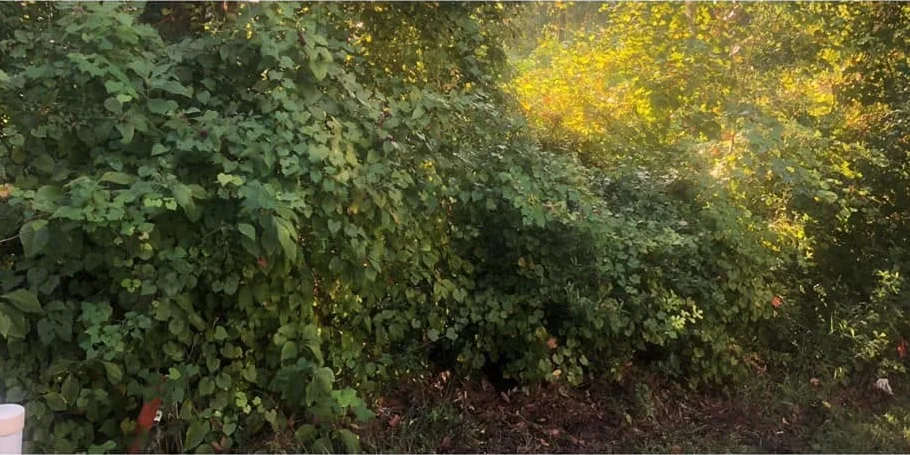
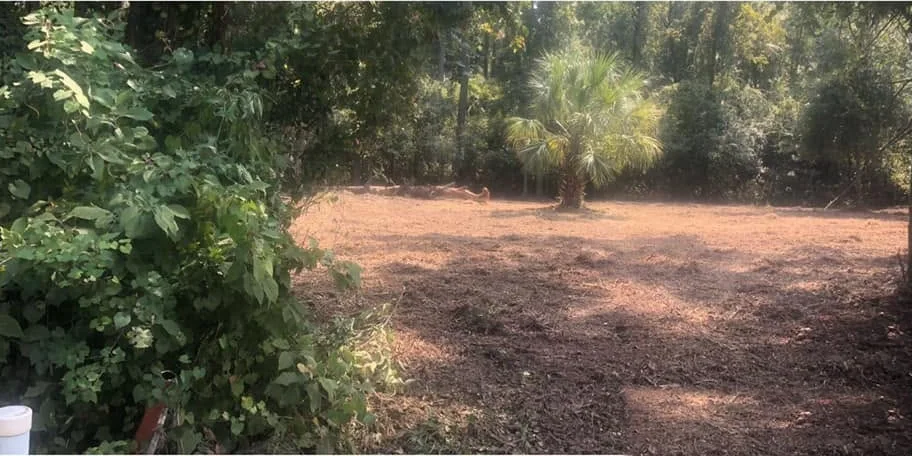 BeforeAfter
Dense overgrowth turned into usable, accessible space.
Why do lots in GA and SC close up so fast?
Long growing seasons, warm winters, and regular rain mean any ground with light on it grows something fast. UGA Extension describes sweetgum as an early-succession tree that seeds prolifically, invades cut-over stands and pine plantations on upland sites, and sprouts from stumps and lateral roots. Loblolly pine is a pioneer species that colonizes abandoned farmland.
Chinese privet is the other reason. Non-native privet ranks first on the Georgia Forestry Commission's 2021 Dirty Dozen list of invasive plants in Georgia forests (source: Georgia Forestry Commission). The SC Exotic Pest Plant Council lists it as a severe threat in every region of the state. The council calls it shade tolerant and notes it forms dense thickets in bottomlands and along fencerows and rights-of-way. Birds carry the seed, so a lot beside a privet hedge is reseeded every winter.
What can forestry mulching do here?
Forestry mulching is a tracked machine with a mulching head that grinds standing brush and small trees in place and leaves them on the ground as a mulch layer. On an overgrown lot it does three things:
- opens the ground so you can walk and see it
- takes down the understory while the trees on your keep list stay standing
- leaves no piles, no bare dirt, and nothing to haul
Selective clearing is RRE's default, and the work can be phased: clear a walking corridor first, decide what you have, then clear the rest. The honest limit is stem size. A mulching head handles brush and small to mid-sized trees; larger trees are kept or felled first by a logger or arborist. What counts as large depends on the machine and head chosen at the site visit, so RRE does not publish a diameter number.
What won't RRE do, and who does that?
Mulching does not make a lot build-ready. If the goal is a house, barn, or driveway, the vegetation work comes first and an excavation or grading contractor does the dirt work. RRE does not grade, strip soil, or build pads, and does not haul: old appliances, wire, concrete, or a collapsed shed stay until a hauling or demolition contractor removes them.
RRE does not spray. If privet or kudzu closed your lot, mechanical clearing knocks it back, but lasting control usually needs a licensed pesticide applicator to treat stumps or regrowth. RRE does not survey; if you are unsure where your line is, a surveyor comes before the machine.
What does the work look like?
The site visit comes first, because photos of a wall of brush show almost nothing. You walk the edge with RRE, talk through what the lot should become, and build the keep list: the trees, features, and areas to protect.
The keep list is flagged on the ground and written into the scope with the agreed boundary of the work area and the intended finish. A rough finish leaves coarser material and is often enough for a lot you just want to walk. A finer finish takes more passes and suits a lot you will mow or show. Equipment is chosen at the site visit, and most single lots are a partial-day to several-day job. See forestry mulching for scope and equipment.
What happens afterward?
The mulch layer settles over the first months and slowly breaks down. Underneath it, the roots of what was cut are alive. Sweetgum and privet resprout from stumps and roots, and bird-dropped seed arrives every winter, so expect green regrowth in the first growing season. The USDA Forest Service field guide to invasive plants of Southern forests notes that Chinese privet colonizes by root sprouts and spreads by abundant bird- and animal-dispersed seed (source: USDA Forest Service). That is normal, and it is why the maintenance visit exists.
A maintenance visit, scheduled ahead or requested as needed, takes regrowth down while it is small and soft, which is far less work than reclaiming the lot a second time. If you want it kept without chemicals, mowing or mulching every year or two is the pattern. If you want privet gone for good, that is where a licensed applicator fits. See Regrowth: what comes back and when.
Rules that may apply
Mulching that leaves roots and soil in place is generally treated differently from grubbing and grading, but the line is drawn by the state and county. In South Carolina, as of October 2026, disturbing 1 acre or more needs coverage under the SCDES Construction General Permit. Sites under 1 acre submit a Notification Form (SCDES Form 2628) and receive a letter of exemption before work begins (source: SCDES). In Georgia, as of October 2026, projects under 1 acre are exempt unless part of a larger common plan or within 200 feet of the bank of state waters. A 25-foot undisturbed buffer applies along state waters (source: Georgia EPD).
Several Lowcountry counties and towns, including Beaufort County, South Carolina, have tree ordinances and lower local thresholds; confirm the current rule with the county planning office. Permits, utility locates (SC811 and Georgia 811), and buffer compliance are the landowner's responsibility. See land clearing permits.
Frequently asked questions
Can I just send photos instead of a site visit?
Photos and a map help start the conversation but never replace the visit. A wall of brush in a photo hides stem sizes, wet spots, stumps, debris, and the trees worth keeping. RRE quotes by project after walking the ground, so the site visit is where the keep list, boundary, and finish get agreed.
Will I lose my big trees?
No. Selective clearing is the default. Trees you want kept go on the keep list, are flagged on the ground, and are written into the scope before the machine arrives. Mulching heads handle brush and smaller trees; anything larger stays or is handled by a logger or arborist, which is decided at the site visit.
Does mulching get rid of the privet for good?
No. Mechanical clearing knocks privet back, but it resprouts from stumps and roots and birds bring new seed every winter. Extension sources agree that repeated cutting controls privet's spread but does not eradicate it without herbicide. RRE does not spray; for lasting control, pair a maintenance visit with a licensed pesticide applicator.
Is the lot ready to build on afterward?
No. Forestry mulching leaves roots and stumps in the ground and a mulch layer on top. That suits walking, showing, or managing a lot and is a good first step before building, but a homesite still needs stump work and then grading by an excavation contractor. RRE does the stump grinding and grubbing; the dirt work is someone else's.
Sources
- SC Exotic Pest Plant Council, Invasive Plant Pest Species of South Carolina: se-eppc.org
- UGA Extension, Native Plants for Georgia Part I (sweetgum, loblolly pine): fieldreport.caes.uga.edu
- SE-EPPC Invasive Plant Manual, Privet: se-eppc.org
- SCDES, Less than 1 Acre of Land Disturbance: des.sc.gov
- Georgia EPD, Model Soil Erosion, Sedimentation and Pollution Control Ordinance: epd.georgia.gov
- South Carolina 811: sc1pups.org ; Georgia 811: georgia811.com
- Georgia Forestry Commission, 2021 Dirty Dozen: Top Twelve Nonnative Invasive Plants List (source: Georgia Forestry Commission)
- USDA Forest Service, A Field Guide for the Identification of Invasive Plants in Southern Forests (GTR SRS-119, rev. 2015) (source: USDA Forest Service)